

Updated PDF (New 2022) Actual ISQI CTAL-TM_Syll2012 Exam Questions
Verified CTAL-TM_Syll2012 Exam Dumps PDF [2022] Access using ValidTorrent
NEW QUESTION 14
Your test team consists of four members (Mary, Bob, Mark, Dave) with different interpersonal skills.
The following skills assessment spreadsheet shows the characteristics of the team members with respect to a list of interpersonal-skills (for each characteristic only the member with the highest level of that characteristic is indicated and marked with 'X'): On the next project a member of your test team will have to perform some routine tasks requiring collaboration with other teams.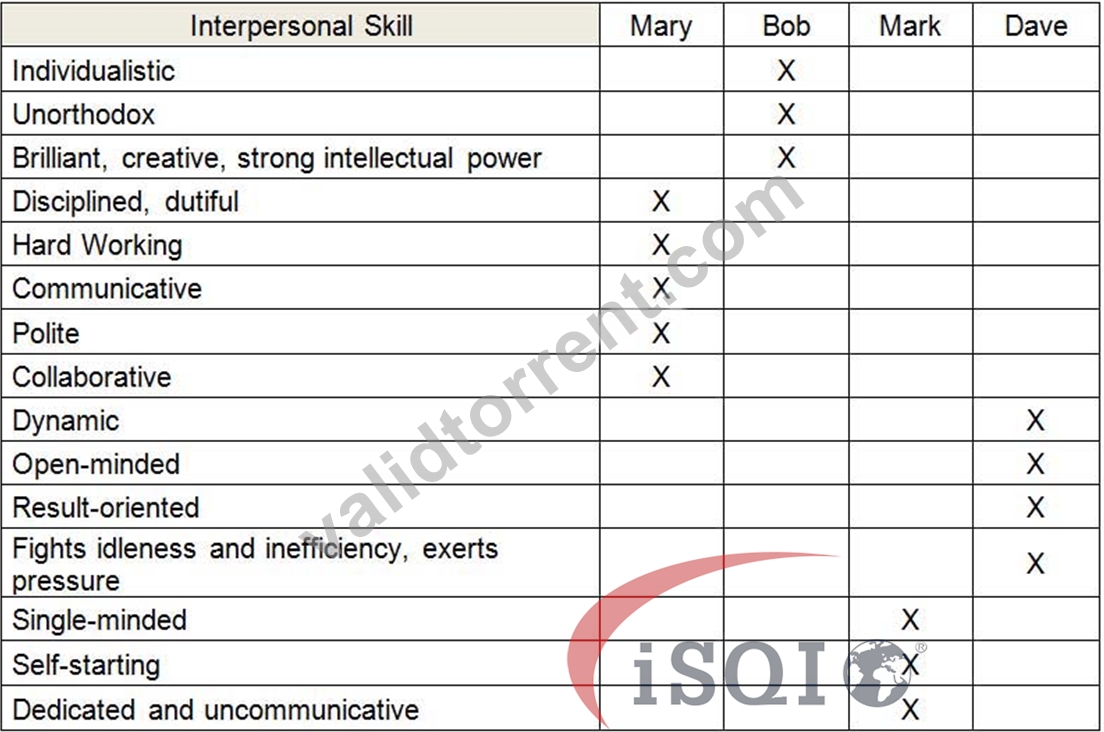
Who in your test team would you expect to be most suitable at doing these tasks?
K4 3 credits
- A. Mark
- B. Bob
- C. Mary
- D. Dave
Answer: C
NEW QUESTION 15
You can count on well-written requirements, but you can't count on an adequate contribution of the stakeholders to the quality risk analysis. You have to mitigate the insufficient contribution of the stakeholders because the risk-based testing approach shall minimize the product risks. Your test team has one expert tester in security testing.
Which of the following test activities would you expect to be the less important in this context?
K4 3 credits
- A. Extract from the defect tracking system of the previous project all the security defects and failures, and classify them to support design and execution of specific tests
- B. Perform exploratory testing sessions with adequate charters covering security aspects
- C. Automate all functional and non-functional system tests
- D. Apply systematic and exploratory testing for integration and system test
Answer: C
NEW QUESTION 16
Assume that the following test cases have been executed at the end of the first week of test execution: TC-
001, TC-002 and TC-007. All these tests are 'passes'.
What is the MINIMUM number of the remaining test cases that must be successfully executed to fulfill the EX1 exit criteria?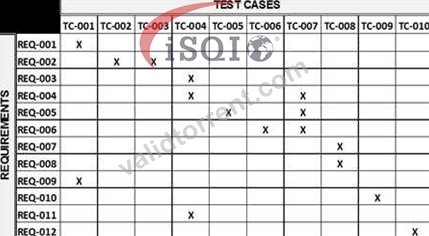
- A. 0
- B. 1
- C. 2
- D. 3
Answer: B
Explanation:
Section: Testing Process
NEW QUESTION 17
Defect Management
Consider a defect report and assume that a part of its lifecycle includes the following states:
New: Is the initial state
Working: Means that the developers are addressing the defect in order to produce a fix for the defect Clarification: Means that the developers need more information from the tester to address the defect and produce a fix for the defect and the tester is working to provide this information to the developers Verification: Means that a fix for the defect has been produced and the tester is running the adequate tests to verify whether the fix solves the defect Closed: is the final state Which of the following answers represents an invalid sequence of states that can't lead the bug report to the
"Closed" state?
Number of correct responses: 1
K2 1 credit
- A. New, Working, Verification, Working, Clarification, Working, Verification, Closed
- B. New, Working, Verification, Closed
- C. New, Working, Clarification, Working, Verification, Closed
- D. New, Working, Verification, Working, Clarification, Working, Closed
Answer: D
NEW QUESTION 18
Test Management
You are the Test Manager of a new project aimed at developing a software system that must be certified at level B of the DO-178B standard. The project will follow a V-Model software development life cycle and it will have four formal levels of testing: component, integration, system and acceptance testing.
You must produce the test plan documentation for this project by providing an adequate coordination across the four levels of testing in order to assure auditability.
Which of the following answers would you expect to best describe how to organize the test plan?
Number of correct responses: 1
K3 2 credits
- A. Produce four separate detailed level test plans, one for each level, without a master test plan
- B. Produce a master test plan that covers three levels (component, integration, system test) and a separate acceptance test plan
- C. Produce a master test plan describing the relationship between the four levels, and four separate detailed level test plans, one for each level
- D. Produce a single master test plan that covers in detail all four levels, describing the particular activities for all test levels
Answer: C
NEW QUESTION 19
Test Management
Which of the following statements about management of product quality risks in mature organizations with respect to the lifecycle, is true?
- A. Mature organizations are aware that risk management of product quality risks only occurs during testing
- B. Mature organizations address product quality risks associated to non-functional characteristics only during the system test phase
- C. Mature organizations don't waste time identifying the sources of risks. They only focus on identifying product quality risks
- D. Mature organizations are aware that the contribution of testing to analysis of product quality risks is very important. The analysis should occur throughout the entire lifecycle
Answer: D
Explanation:
Section: Test Management
NEW QUESTION 20
Reviews
Consider the following list of statements about audits and management reviews:
I. Audits are usually more effective than management reviews at finding defects II. Audits and management reviews have the same main goals, the only difference is related to the roles and level of formality III. A typical outcome of an audit includes observations and recommendations, corrective actions and a pass/fail assessment IV. An audit is not the appropriate mechanism to use at the code review in order to detect defects prior to dynamic testing Which of the following statements is true?
Number of correct responses: 1
K2 1 credit
- A. II. and III are true; I. and IV. are false;
- B. I. and III. are true; II. and IV. are false;
- C. I, III and IV are true; II. is false;
- D. III. and IV. are true; I and II are false;
Answer: D
NEW QUESTION 21
Assume that you are the Test Manager for a small banking application development project.
You have decided to adopt a risk-based testing strategy and 5 product risks (R1, R2, R3, R4, and R5) have been identified during the quality risk analysis.
The following table shows the risk level associated to these product risks (higher numbers mean higher risk):
55 test cases have been designed and implemented to cover all these 5 product risks. The coverage is described in a traceability matrix.
This is the test execution status table, after the after the first week of test execution:
About 56% of the planned test cases have been successfully executed.
Assume that no additional product risks have been identified during the first week of test
execution.
Which of the following answers would you expect to best describe the residual risks associated with the identified product risks, at the end of the first week of test execution?
K3 2 credits
- A. The residual risk level can't be determined, because it requires that all the test cases have been executed
- B. Since R3 is the only risk for which all test cases have passed, the risk has been reduced by 20%
- C. The test execution status table indicates that the risk has been reduced by 56%
- D. The test execution table doesn't give an indication of the risk level of the open defects and the test cases that failed or are not run yet
Answer: D
NEW QUESTION 22
Test Management
You are the Test Manager on a project following an iterative life-cycle model. The project should consist of nine iterations of one month duration each. It is planned to develop the most important features to have a stable core of the application in the first three iterations and to add the additional features in the last six iterations.
At the beginning of the first iteration, only a draft version of the requirements specification document for the core features is available. Assume that during each of the first three iterations, the chosen features are fully completed and unit tested.
Which of the following statements is true in this context?
- A. You should allocate a large effort for system testing during the first three iterations
- B. You should allocate all the effort for the system test phase only in the last iteration
- C. The system test phase should start when all the requirements are frozen
- D. You should apply the same test strategy as used in a sequential life cycle model
Answer: A
NEW QUESTION 23
Consider an agile team adopting Extreme Programming (XP) with five developers and one tester without any coding experience.
To which of the following activities would you expect the tester will contribute most?
K2 1 credit
- A. Developing unit tests
- B. Supporting the customer in the execution of acceptance testing
- C. Executing unit tests
- D. Planning and executing tests during the integration test phase to detect interface defects
Answer: B
NEW QUESTION 24
In your organization the following tools of the same vendor are currently in usE. a requirements management tool, a test management tool and a bug tracking tool.
You are the Test Manager.
You are currently evaluating a test automation tool of the same vendor (to complete the vendor's tool suite) against an interesting open-source test automation tool under the GNU GPL (General Public License).
There are no initial costs associated to that open-source tool.
Which of the following statements associated to the selection of the open-source tool is correct in this scenario?
K2 1 credit
- A. The open-source tool can be modified but only if the community of developers of that tool gives you the formal permission to modify it
- B. There are no initial costs for the open-source tool because open-source tools are usually low-quality, while vendor tools have always a better quality than the corresponding open-source tools
- C. The open-source tool can be modified but it can't be distributed further in any way
- D. There are no initial costs for the open-source tool but you should carefully consider the costs associated to the integration with the existing tools and also evaluate the recurring costs
Answer: D
NEW QUESTION 25
Test Management
Which of the following statements describing how identified product quality risks should be mitigated and managed, is true?
Number of correct responses: 1
K2 1 credit
- A. The identification of new risks, the re-assessment of the level of existing risks and the evaluation of the effectiveness of risk mitigation activities should only occur at the very beginning of a project
- B. The priority of the development and execution of tests should not be based on the risk level but only on the likelihood
- C. Risk mitigation of product quality risks can be effective only after starting test execution
- D. The extent of re-testing and regression testing activities should be based on the risk level
Answer: D
NEW QUESTION 26
Which of the following statements about the STEP test process improvement model is true?
K2 1 credit
- A. The STEP model stresses defect detection and demonstration of capability, whereas the defect prevention is a secondary potential goal of testing
- B. In the STEP model, testware design occurs after coding
- C. The STEP model assures that the system requirements specification and the test design specification processes don't overlap
- D. In the STEP model, tests validate the requirements and use cases when they are developed
Answer: D
NEW QUESTION 27
The following is the unique "critical" quality risk item that has been identified:
CR-RSK-1. The GUI of the application might accept non-integer values for the input field designed to get the number of bottles from the user Test analysis for system testing has just begun and the following test conditions have been identified:
TC-SEL-2. Test the selection of the package sizes
TC-SEL-4. Test wrong numbers of bottles for an order
TC-CR-RSK-1. Test the accepted values from the input field designed to get the number of bottles from the user Assume that you have used traceability to determine the logical test cases that cover all the requirements and the single risk item identified in that scenario.
Which of the following is a positive logical test that is complete and correct, and covers the REQ-SEL-4 requirement?
- A. Select a 6-bottles package, then try to insert 7 bottles; verify that no error messages are displayed
- B. Select a 6-bottles package, then try to insert 5 bottles; verify that no error messages are displayed
- C. Select a 6-bottles package, then try to insert 7 bottles; verify that the "Invalid number of bottles" message is displayed
- D. Select a 6-bottles package, then try to insert 7 bottles
Answer: C
Explanation:
Section: Testing Process
NEW QUESTION 28
Test Management
Assume you are managing the system testing phase of a project.
The system test execution period is scheduled to twenty weeks.
All tests are manual tests. You are following a risk-driven test approach.
During the last staff meeting the project manager tells you new deadlines that will not allow completion of all the system tests.
Which of the following would you expect to be the best way to respond to this situation?
- A. Remove testers from your test team, so that they can be assigned to other projects
- B. Prioritize executing the tests for the highest product risks and track these risks
- C. No action is needed, test as much as possible in the remaining time period
- D. Automate all remaining tests
Answer: B
Explanation:
Section: Test Management
NEW QUESTION 29
Which of the following statements represents the most effective contribution of the stakeholders to the completion of the failure mode analysis table?
Number of correct responses: 1
K4 3 credits
- A. The aircraft pilot and the customer representative should contribute to assess the detection. The chief software engineer, the system architect and the expert tester should contribute to assess the priority.
- B. The system architect and the chief software engineer should contribute to assess the priority. The expert tester is the only one who should contribute to assess the detection.
- C. The aircraft pilot and the customer representative should contribute to assess the priority. The chief software engineer, the system architect and the expert tester should contribute to assess the detection.
- D. The aircraft pilot is the only one qualified to contribute to assess the priority and thus should be assigned this task. The customer representative should contribute to assess the detection.
Answer: C
NEW QUESTION 30
Test Management
You are the Test Manager on a project following an iterative life-cycle model. The project should consist of nine iterations of one month duration each. It is planned to develop the most important features to have a stable core of the application in the first three iterations and to add the additional features in the last six iterations.
At the beginning of the first iteration, only a draft version of the requirements specification document for the core features is available. Assume that during each of the first three iterations, the chosen features are fully completed and unit tested.
Which of the following statements is true in this context?
- A. You should allocate a large effort for system testing during the first three iterations
- B. You should allocate all the effort for the system test phase only in the last iteration
- C. The system test phase should start when all the requirements are frozen
- D. You should apply the same test strategy as used in a sequential life cycle model
Answer: A
Explanation:
Section: Test Management
NEW QUESTION 31
Test Tools and Automation
After a selection process you have selected a test management tool that is going be introduced in your organization and used by your test team in a pilot project.
You have already identified the member of your test team who will be the administrator of the tool, since he/she has a significant experience with the administration of test management tools and so he/she is able to make effective and efficient up-front decisions about "how" the tool will be used. You have also developed a training plan for the other members of your test team.
In collaboration with the administrator of the tool you have also devised standard ways of managing, storing and maintaining the tool and its assets including backup/restore procedures.
You have also analyzed standard formats supported by the tool (CSV, XLS, XML, etc.) to export, import and archive all the information managed by the tool itself (requirements, test case specifications, test plans etc.) for compliance with the most important test management tools, in order to minimize the impacts of migrating this information to a new tool that could replace the existing one in the future.
Which of the following phases in the lifecycle of the new tool has NOT been adequately considered in this description?
Number of correct responses: 1
K2 1 credit
- A. Retirement
- B. Acquisition
- C. Evolution
- D. Support and maintenance
Answer: C
NEW QUESTION 32
Testing Process
Consider an information system of a Pay-Tv company based on a SOA architecture.
The integrated system currently consists of three core systems:
- a CRM (Customer Relationship Management) system
- a BRM (Billing and Revenue Management) system
- a CAS (Conditional Access System) system
all of them communicating with SOA Middleware.
You have been asked to manage the testing activities for the integration of two additional off-the-shelf systems from two different vendors: a SMS (Short Message Service) server and an IVR (Interactive Voice Response) system.
Assume that there is a high likelihood that the two off-the-shelf systems will be low-quality and that you have a clear proof that the testing performed by the two vendors on their systems has been unsystematic and unprofessional. This obviously leads to higher quality risk for the overall integrated system.
You are the Test Manager of this project. Your main goal is to plan for testing activities to mitigate this risk.
Which of the following answers best describes the test activities (assuming it is possible to perform all of them) you should plan for?
Number of correct responses: 1
K4 3 credits
- A. You should plan for an informal and minimal acceptance test of the two off-the-shelf systems and then a single end-to-end test of the overall integrated system
- B. You should plan for two levels: a system integration test and an end-to-end test of the overall integrated system
- C. You should directly plan for a single end-to-end test focused on end-to-end tests of the overall integrated system without an acceptance test of the two off-the-shelf systems
- D. You should plan for adequate re-testing of both the systems followed by a system integration test and an end-to-end test of the overall integrated system
Answer: D
NEW QUESTION 33
You are the Test Manager of a new project that will have three formal levels of testinG. unit, integration and system testing. The testing strategy you decide to adopt a blend of risk-based testing and reactive testing strategies.
Which of the following answers describes the most consistent example of implementation of this test strategy during the execution of the system tests?
K2 1 credit
- A. Your test team executes scripted tests designed and implemented before the execution of the system test phase, to cover the identified product risks. It also performs exploratory testing sessions throughout the system test phase
- B. Your test team autonomously performs some exploratory testing sessions and, at the very end of the system testing phase, it also executes more system tests under the guidance of a sample of users
- C. Your test team executes system tests under the guidance of a sample of users throughout the system test phase
- D. Your test team executes exploratory tests following a session-based test management approach throughout the system test phase
Answer: A
NEW QUESTION 34
You are following a risk-based testing strategy. The test execution time is very limited. Assume that all the product risk items require more or less the same level of test effort.
Which of the following answers describes the best execution schedule in this scenario?
- A. 1- Test the correct pre-activation of the Smart Card
2- Test the correct activation of the Smart Card
3- Test the correct charge of the Smart Card with the required contents
4- Test the acceptance of transactions coming from the IVR channel - B. 1- Test the acceptance of transactions coming from the IVR channel
2- Test the correct charge of the Smart Card with the required contents
3- Test the correct pre-activation of the Smart Card
4- Test the correct activation of the Smart Card - C. 1- Test the correct activation of the Smart Card
2- Test the correct pre-activation of the Smart Card
3- Test the correct charge of the Smart Card with the required contents
4- Test the acceptance of transactions coming from the IVR channel - D. 1- Test the correct pre-activation of the Smart Card
2- Test the correct charge of the Smart Card with the required contents
3- Test the correct activation of the Smart Card
4- Test the acceptance of transactions coming from the IVR channel
Answer: A
Explanation:
Section: Testing Process
NEW QUESTION 35
Which of the following statements represents the most effective contribution of the stakeholders to the completion of the failure mode analysis table?
- A. The aircraft pilot and the customer representative should contribute to assess the detection. The chief software engineer, the system architect and the expert tester should contribute to assess the priority.
- B. The system architect and the chief software engineer should contribute to assess the priority. The expert tester is the only one who should contribute to assess the detection.
- C. The aircraft pilot and the customer representative should contribute to assess the priority. The chief software engineer, the system architect and the expert tester should contribute to assess the detection.
- D. The aircraft pilot is the only one qualified to contribute to assess the priority and thus should be assigned this task. The customer representative should contribute to assess the detection.
Answer: C
NEW QUESTION 36
......
ISQI CTAL-TM_Syll2012 Exam Syllabus Topics:
| Topic | Details |
|---|---|
| Topic 1 |
|
| Topic 2 |
|
| Topic 3 |
|
Try Best CTAL-TM_Syll2012 Exam Questions from Training Expert ValidTorrent: https://passguide.validtorrent.com/CTAL-TM_Syll2012-valid-exam-torrent.html