

Verified JN0-351 dumps Q&As - Pass Guarantee or Full Refund [May-2026]
JN0-351 PDF Dumps | May 20, 2026 Recently Updated Questions
NEW QUESTION # 50
Which two elements are used to create the STP bridge ID? (Choose two.)
- A. the bridge priority value
- B. the root port number
- C. the port cost
- D. the system MAC address
Answer: A,D
NEW QUESTION # 51
Exhibit.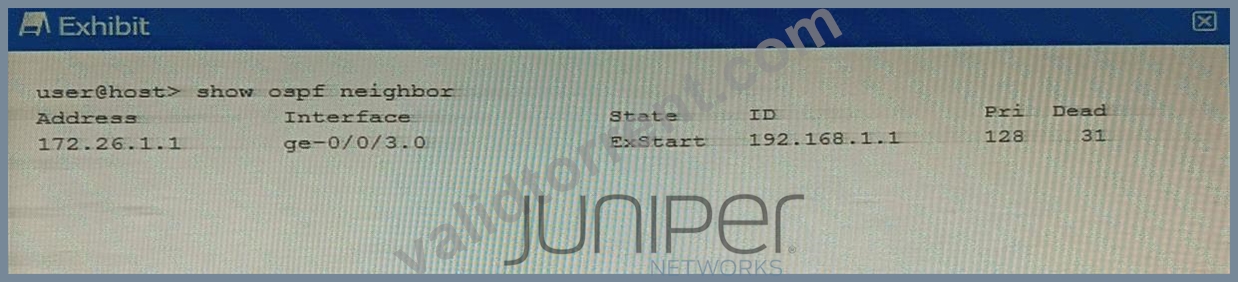
Why is this OSPF adjacency remaining in this state?
- A. An area ID mismatch exists between the OSPF neighbors
- B. A hello interval mismatch exists between the OSPF neighbors.
- C. An MTU mismatch exists between the OSPF neighbors.
- D. A subnet mask mismatch exists between the OSPF neighbors.
Answer: C
Explanation:
* The exhibit shows the output of the command show ospf neighbor , which displays information about the OSPF neighbors on a router 1 .
* The output shows that the OSPF neighbor with the address 172.26.1.1 and the interface ge-0/0/3.0 is in the Exstart state 1 .
* The Exstart state is the fourth state in the OSPF neighbor formation process, after Down, Init, and 2- Way states 2 . In this state, the OSPF neighbors establish a master-slave relationship and exchange database description (DBD) packets, which contain summaries of their link-state databases 2 .
* The most common reason for OSPF neighbors to be stuck in the Exstart state is an MTU mismatch between the interfaces 3 . MTU stands for maximum transmission unit, which is the largest size of a packet that can be transmitted on a network segment 4 . If the MTU values of two OSPF neighbors are different, they may not be able to exchange DBD packets successfully, as some packets may be dropped or fragmented due to their size exceeding the MTU limit 3 .
* To solve this problem, you need to ensure that the MTU values of both OSPF neighbors are the same or compatible. You can use the command show interfaces to display the MTU value of an interface 5 .
You can also use the command ping with the do-not-fragment option to test the MTU size between two routers. You can change the MTU value of an interface by using the command set interfaces interface-name mtu mtu-value in configuration mode 5 .
NEW QUESTION # 52
You are asked to create a default route that will be advertised to your internal OSPF neighbors. You have three upstream connections to the Internet and you must ensure that when available, all traffic uses ISP1 as your primary connection and only uses ISP2 and ISP3 when ISP1 is not available.
Which solution should you implement in this scenario?
- A. Create a default aggregated route.
- B. Create a default static route with each neighbor address as the next hop.
- C. Create a default generate route that includes an import policy to match BGP routes from ISP1 and assign a preference value of four or less.
- D. Create a default static route with ISP1 ' s address as the next hop while specifying the addresses for ISP2 and ISP3 as qualified next hops with a preference value of six or higher.
Answer: D
Explanation:
The solution that should be implemented in this scenario is to create a default generate route that includes an import policy to match BGP routes from ISP1 and assign a preference value of four or less. This way, the default route will be advertised to the internal OSPF neighbors only when there is a BGP route from ISP1 in the routing table, and it will have a higher preference than any other default route from ISP2 or ISP3. If ISP1 is not available, the default generate route will be withdrawn and the traffic will use the next available default route from ISP2 or ISP3.
Option A is incorrect because creating a default static route with ISP1's address as the next hop while specifying the addresses for ISP2 and ISP3 as qualified next hops with a preference value of six or higher will not ensure that the default route is advertised to the internal OSPF neighbors only when ISP1 is available. The default static route will always be in the routing table regardless of the availability of ISP1, and it will have a lower preference than any other default route from ISP2 or ISP3.
Option C is incorrect because creating a default static route with each neighbor address as the next hop will not ensure that all traffic uses ISP1 as the primary connection and only uses ISP2 and ISP3 when ISP1 is not available. The default static route will always be in the routing table regardless of the availability of ISP1, and it will load balance the traffic among the three ISPs.
Option D is incorrect because creating a default aggregated route will not ensure that the default route is advertised to the internal OSPF neighbors only when ISP1 is available. The default aggregated route will always be in the routing table regardless of the availability of ISP1, and it will not have any preference value associated with it. References:
* Enterprise Routing and Switching, Specialist (JNCIS-ENT) - Juniper Networks
* Enterprise Routing and Switching, Specialist (JNCIS-ENT) - Juniper Networks
NEW QUESTION # 53
Which two statements are correct about IS-IS? (Choose two.)
- A. IS-IS has two metric types and Junos sends both by default.
- B. IS-IS sends a maximum metric value of 63 by default.
- C. IS-IS only allows you to configure two areas.
- D. IS-IS uses IPv6 as its transport protocol in the Junos OS Implementation.
Answer: A,D
NEW QUESTION # 54
What is the default keepalive time for BGP?
- A. 10 seconds
- B. 30 seconds
- C. 90 seconds
- D. 60 seconds
Answer: B
Explanation:
The default hold-time is 90 seconds, meaning that the default frequency for keepalive messages is 30 seconds.
https://www.juniper.net/documentation/us/en/software/junos/bgp/topics/ref/statement/precision- timers-edit-protocols- bgp.html#:~:text=BGP%20on%20the%20local%20routing,keepalive%20messages%20is%2030
%20seconds
NEW QUESTION # 55
You have configured a GRE interface, but no traffic will flow.
Referring to the exhibit, which statement is true?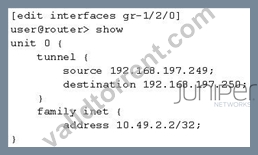
- A. The source and destination addresses cannot have the same third octet.
- B. The IP subnet mask cannot be a /32.
- C. The unit number cannot be 0.
- D. The gr-1/2/0 interface is an invalid GRE interface.
Answer: B
NEW QUESTION # 56
Which two statements about redundant trunk groups on EX Series switches are correct? (Choose two.)
- A. If the active link fails, then the secondary link automatically takes over.
- B. Redundant trunk groups use spanning tree to provide loop-free redundant uplinks.
- C. Redundant trunk groups load balance traffic across two designated uplink interfaces.
- D. Layer 2 control traffic is permitted on the secondary link.
Answer: A,D
Explanation:
Redundant trunk groups are designed to provide link redundancy. If the primary link fails, the secondary link will automatically take over to ensure continued connectivity.
In redundant trunk groups, while regular data traffic is sent over the primary link, Layer 2 control traffic (such as STP, LACP, etc.) is allowed on the secondary link to maintain network stability and protocol operations.
https://www.juniper.net/documentation/us/en/software/junos/multicast-l2/topics/topic- map/redundant-trunk-groups.html
NEW QUESTION # 57
Which two statements about redundant trunk groups on EX Series switches are correct? (Choose two.)
- A. If the active link fails, then the secondary link automatically takes over.
- B. Redundant trunk groups use spanning tree to provide loop-free redundant uplinks.
- C. Redundant trunk groups load balance traffic across two designated uplink interfaces.
- D. Layer 2 control traffic is permitted on the secondary link.
Answer: A,D
Explanation:
C is correct because Layer 2 control traffic is permitted on the secondary link of a redundant trunk group (RTG) on EX Series switches. Layer 2 control traffic includes protocols such as LLDP, LACP, and STP, which are used to exchange information and coordinate actions between switches1. According to the Juniper Networks documentation2, Layer 2 control traffic is allowed to pass through both the active and the secondary links of an RTG, but data traffic is only forwarded through the active link. This allows the switches to maintain their Layer 2 adjacencies and monitor the link status on both links.
D is correct because if the active link fails, then the secondary link automatically takes over in an RTG on EX Series switches. An RTG consists of two trunk links: an active or primary link, and a secondary or backup link2. The active link is used to forward data traffic, while the secondary link is in standby mode. If the active link fails or becomes unavailable, the secondary link immediately transitions to a forwarding state and takes over the data traffic without waiting for normal STP convergence2. This provides fast recovery and redundancy for the network.
NEW QUESTION # 58
Exhibit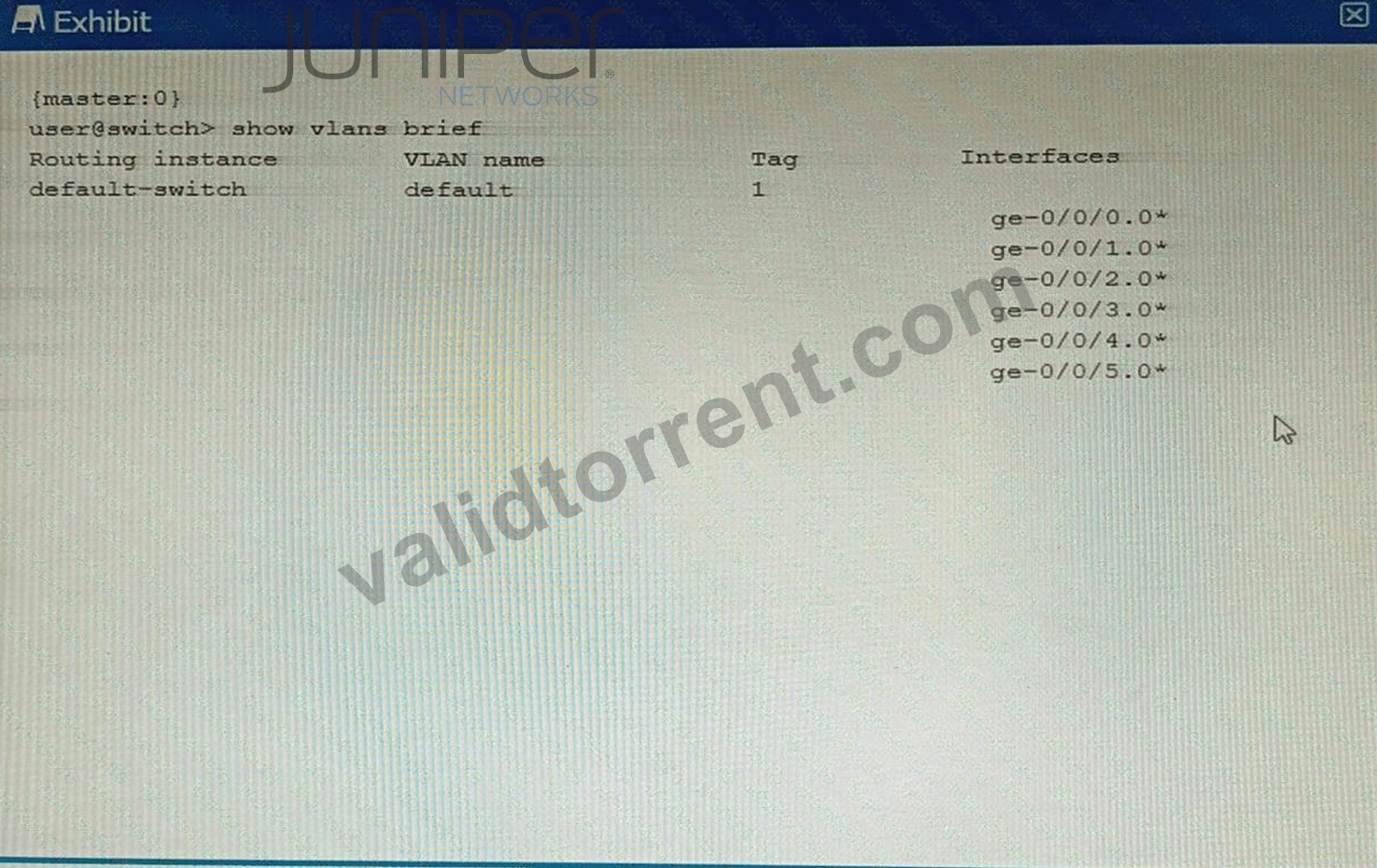
What does the * indicate in the output shown in the exhibit?
- A. All interfaces have elected a root bridge.
- B. The interface is active.
- C. The interface is down.
- D. The switch ports have a router attached.
Answer: B
Explanation:
* The exhibit shows the output of the command show vlans brief , which displays brief information about VLANs and their associated interfaces 1 .
* The output has four columns: Routing instance, VLAN name, Interfaces, and Tagging.
* The * symbol indicates that the interface is active, meaning that it is up and forwarding traffic 1 . This can be verified by the command show interfaces terse , which displays the status of the interfaces 2 .
NEW QUESTION # 59
Which statement is correct about IP-IP tunnels?
- A. There are 24 bytes of overhead with IP-IP encapsulation.
- B. IP-IP tunnels only support encapsulating non-IP traffic.
- C. IP-IP tunnels only support encapsulating IP traffic.
- D. The TTL in the inner packet is decremented during transit to the tunnel endpoint.
Answer: C
Explanation:
"The ENCAPSULATOR does not change the inner IP header, except to decrement the TTL and it remains unchanged during its deliver to the endpoint" - only router that encapsulates the inner packet decrements its TTL - during transit, the inner packet is unchanged.
NEW QUESTION # 60
Which statement is true about IP-IP tunnels?
- A. The packet header is replaced before entering the tunnel.
- B. The packet is encapsulated unchanged before entering the tunnel.
- C. IP-IP tunnels are protocol agnostic.
- D. The time-to-live value of the original packet is decremented.
Answer: C
NEW QUESTION # 61
What are two characteristics of RSTP alternate ports? (Choose two.)
- A. RSTP alternate ports provide an alternate lower cost path to the root bridge.
- B. RSTP alternate ports are active ports used to forward frames toward the root bridge.
- C. RSTP alternate ports provide an alternate higher cost path to the root bridge.
- D. RSTP alternate ports block traffic while receiving superior BPDUs from a neighboring switch.
Answer: C,D
Explanation:
A is correct because RSTP alternate ports block traffic while receiving superior BPDUs from a neighboring switch. An alternate port is a backup port for a root port, which means it receives better BPDUs from another bridge than the current root port1. However, an alternate port does not forward any traffic, as it is in a discarding state2. It only listens to BPDUs and waits for the root port to fail. If the root port fails, the alternate port can immediately transition to a forwarding state and become the new root port1.
C is correct because RSTP alternate ports provide an alternate higher cost path to the root bridge. An alternate port is selected based on the same criteria as the root port, which are the lowest bridge ID, the lowest path cost, the lowest sender port ID, and the lowest receiver port ID3. However, an alternate port receives a higher cost BPDU than the root port, otherwise it would be the root port itself1. Therefore, an alternate port provides an alternate higher cost path to the root bridge than the root port.
NEW QUESTION # 62
You are an operator for a network running 1S-IS. Two routers are failing to form an adjacency. What are two reasons for this problem? (Choose two.)
- A. The family iso configuration is missing from the adjacency interface.
- B. There is no configured ISO address on any IS-IS interface.
- C. There is a mismatched area ID between the L2 routers.
- D. There are mismatched router IDs on the L2 routers.
Answer: A,B
Explanation:
Explanation
The two reasons for the failure to form an adjacency in a network running IS-IS could be:
B: There is no configured ISO address on any IS-IS interface. IS-IS requires each router interface to have an ISO address configured. Without this address, the routers cannot form an adjacency1.
D: The family iso configuration is missing from the adjacency interface. The 'family iso' configuration is essential for IS-IS to function correctly. If this configuration is missing from the adjacency interface, it could prevent the formation of an adjacency1.
These explanations are based on the Enterprise Routing and Switching Specialist (JNCIS-ENT) documents and learning resources available at Juniper Networks23.
NEW QUESTION # 63
The ISP1.inet.0 route table has currently no routes in it.
What will happen when you commit the configuration shown on the exhibit?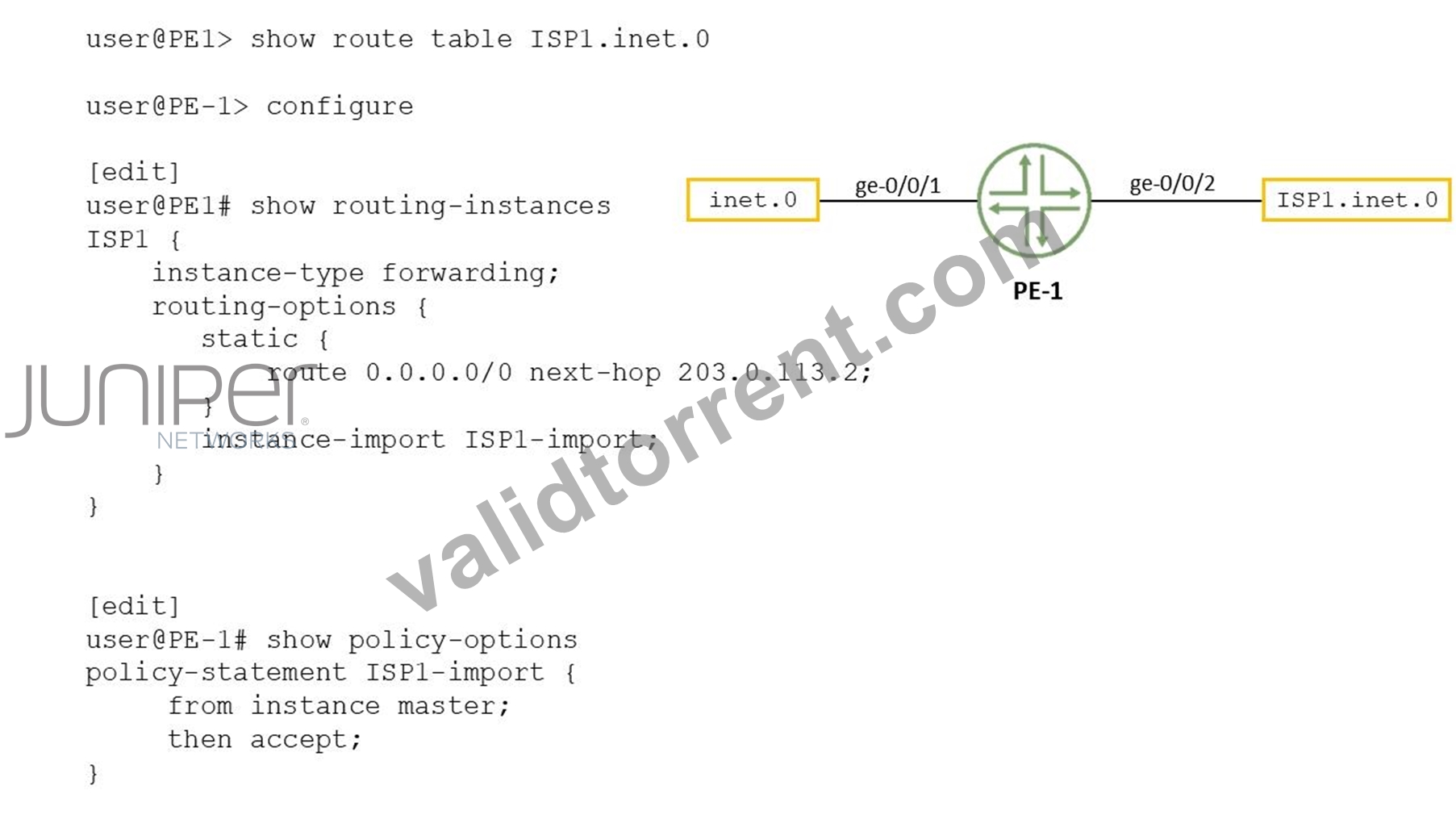
- A. The ISP1.inet.0 route table will be completely overwritten by the inet.0 route table.
- B. The inet.0 route table will be completely overwritten by the ISP1.inet.0 route table.
- C. The ISP1.inet.0 route table will be imported into the inet.0 route table.
- D. The inet.0 route table will be imported into the ISP1.inet.0 route table.
Answer: D
Explanation:
The configuration shown in the exhibit is an example of a routing instance of type virtual-router. A routing instance is a collection of routing tables, interfaces, and routing protocol parameters that create a separate routing domain on a Juniper device. A virtual-router routing instance allows administrators to divide a device into multiple independent virtual routers, each with its own routing table.
The configuration also includes a rib-group statement, which is used to import routes from one routing table to another. A rib-group consists of an import-rib statement, which specifies the source routing table, and an export-rib statement, which specifies the destination routing table. In this case, the rib-group name is inet-to-ispi, and the import-rib statement specifies inet.0 as the source routing table. The export-rib statement specifies ispi.inet.0 as the destination routing table.
This means that the routes from inet.0 will be imported into ispi.inet.0.
NEW QUESTION # 64
Your ISP is announcing a default route to both R1 and R2. You want your network routers to forward all Internet traffic through the R1 device.
Which BGP attribute would you use?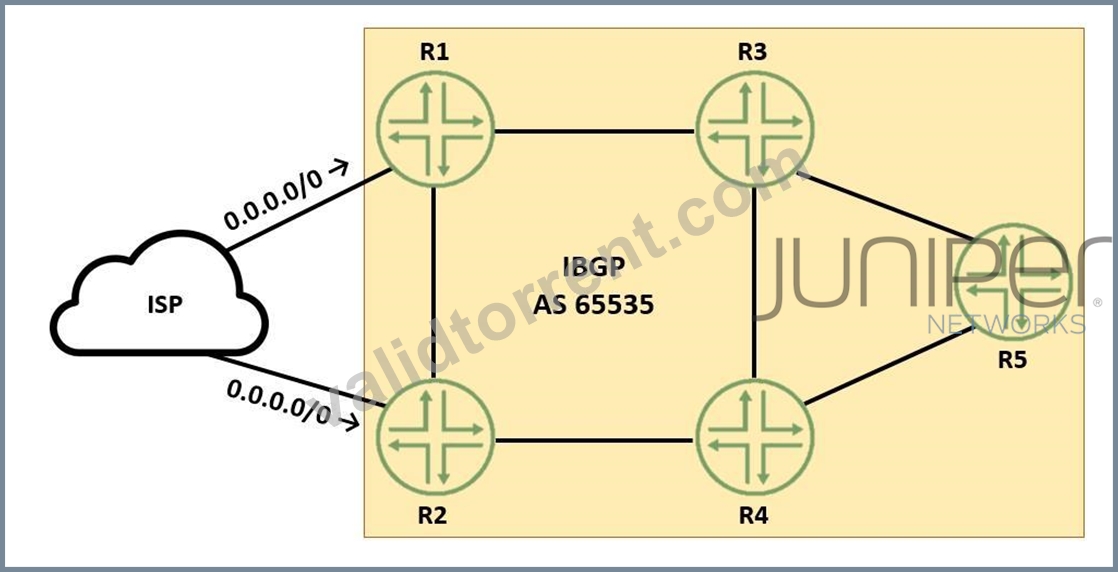
- A. local preference
- B. next-hop
- C. origin
- D. MED
Answer: A
Explanation:
The BGP attribute that you would use to forward all Internet traffic through the R1 device is the local preference.
The local preference is an attribute that is used within an autonomous system (AS) and exchanged between iBGP routers. It is used to select an exit point from the AS. The path with the highest local preference is preferred. By setting a higher local preference for the routes received from R1, you can make R1 the preferred exit point for all Internet traffic.
NEW QUESTION # 65
Which statement is correct about the storm control feature?
- A. The storm control feature is not supported on aggregate Ethernet interfaces.
- B. The storm control feature is enabled in the factory-default configuration on EX Series switches.
- C. The storm control feature requires a special license on EX Series switches.
- D. The storm control configuration only applies to traffic being sent between the forwarding and control plane.
Answer: B
Explanation:
The storm control feature is enabled in the factory-default configuration on EX Series switches.
On EX2200, EX3200, EX3300, EX4200, and EX6200 switches, the factory default configuration enables storm control for broadcast and unknown unicast traffic on all switch interfaces. On EX4300 switches, the factory default configuration enables storm control on all Layer 2 switch interfaces.
NEW QUESTION # 66
You need to configure a LAG between your switches. In this scenario, which two statements are correct?
(Choose two.)
- A. Member links are required to be contiguous ports.
- B. Member links are not required to be contiguous ports.
- C. Duplex and speed settings are required to match on both participating devices.
- D. Duplex and speed settings are not required to match on both participating devices.
Answer: B,C
Explanation:
B is correct because duplex and speed settings are required to match on both participating devices. According to the Juniper Networks documentation1, all the interfaces in a LAG must have the same speed and be in full-duplex mode. This ensures that the LAG can operate as a single logical link without any performance or compatibility issues.
C is correct because member links are not required to be contiguous ports. According to the Juniper Networks documentation2, you can group any Ethernet interfaces on a switch into a LAG, regardless of their physical location or slot number. This provides flexibility and scalability for configuring LAGs on switches.
NEW QUESTION # 67
Referring to the output shown in the exhibit, which two statements are true?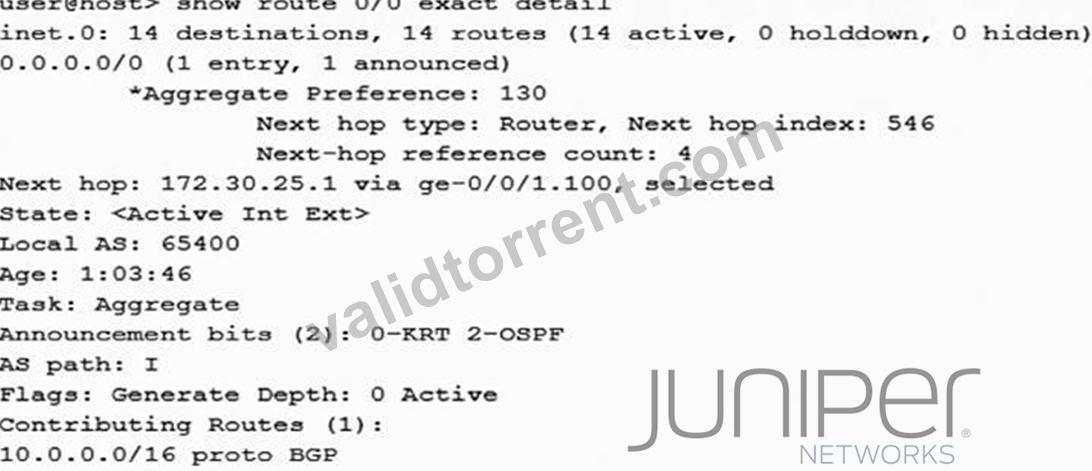
- A. The route is not active
- B. The route is a generate route
- C. The route is active
- D. The route is an aggregate route
Answer: B,C
NEW QUESTION # 68
Two routers share the same highest priority and start time.
- A. In this situation, what is evaluated next when determining the designated router? The router with the lowest router ID become the DR.
- B. The router with the highest router ID becomes the DR
- C. The routers perform another DR election.
- D. The router with the highest MAC address become the DR
Answer: B
Explanation:
According to the OSPF protocol, the designated router (DR) is the router that acts as the focal point for exchanging routing information on a multi-access network segment, such as a LAN1. The DR election process is based on the following criteria, in order of precedence1:
The router with the highest OSPF priority becomes the DR. The default priority is 1, and a priority of 0 means the router will not participate in the election.
If there is a tie in priority, the router with the highest router ID becomes the DR. The router ID is a 32-bit number that uniquely identifies a router in an OSPF domain. It can be manually configured or automatically derived from the highest IP address of a loopback interface or a physical interface.
If there is a tie in router ID, the router that was first to become an OSPF neighbor becomes the DR.
In your scenario, two routers share the same highest priority and start time. This means that they have equal chances of becoming the DR based on the first and third criteria. Therefore, the second criterion will be used to break the tie, which is the router ID. The router with the highest router ID will become the DR, and the other router will become the backup designated router (BDR), which is ready to take over the role of DR if it fails1.
NEW QUESTION # 69
You implemented the MAC address limit feature with the shutdown action on all interfaces on your switch.
In this scenario, which statement is correct when a violation occurs?
- A. By default, the interface will continue to send and receive traffic for all connected devices after a violation has occurred.
- B. By default, the violation will automatically be cleared after 300 seconds and the interface will resume sending and receiving traffic for all learned devices.
- C. By default, devices that are learned before the violation occurs are still allowed to send and receive traffic through the specific interface.
- D. By default, you must manually clear the violation for the interface to send and receive traffic again.
Answer: D
Explanation:
When the MAC address limit feature with the shutdown action is implemented on a switch, if a violation occurs, the interface is disabled and a system log entry is generated 1 . If the switch has been configured with the port-error-disable statement, the disabled interface recovers automatically upon expiration of the specified disable timeout 1 . However, if the switch has not been configured for auto-recovery from port error disabled conditions, you must manually clear the violation by running the clear ethernet-switching port-error command for the interface to send and receive traffic again 1 . This explanation is based on the Enterprise Routing and Switching Specialist (JNCIS-ENT) documents and learning resources available at Juniper Networks 1 .
NEW QUESTION # 70
Click the Exhibit button.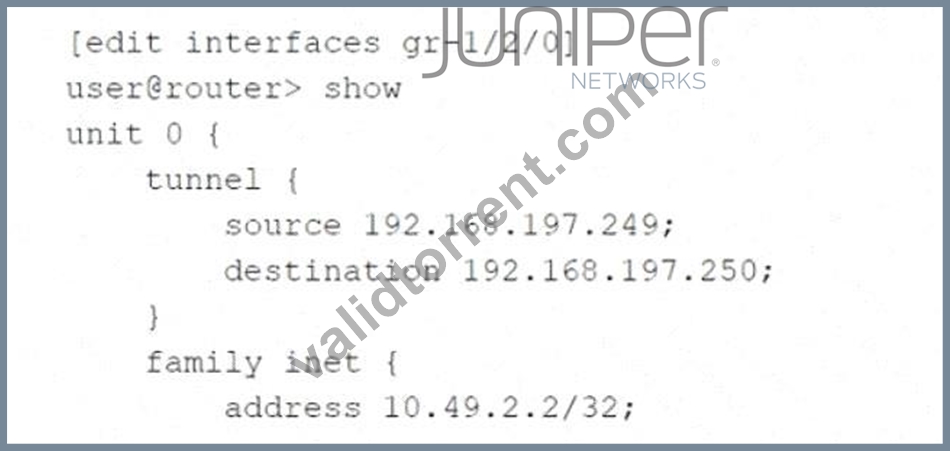
You have configured a GRE interface, but no traffic will flow.
Referring to the exhibit, which statement is true?
- A. The IP subnet mask cannot be a /32.
- B. The unit number cannot be 0.
- C. The gr-1/2/0 interface is an invalid GRE interface.
- D. The source and destination addresses cannot have the same third octet.
Answer: D
Explanation:
According to the Juniper documentation 1 , the source and destination addresses of a GRE tunnel interface must be in different subnets. If they are in the same subnet, the router will not be able to route the GRE packets correctly. In the exhibit, the source and destination addresses are both in the 192.168.197.0/24 subnet, which is invalid for GRE tunneling. Therefore, the correct answer is D. References: Configuring GRE Tunnel Interfaces | Junos OS
NEW QUESTION # 71
Click the Exhibit button.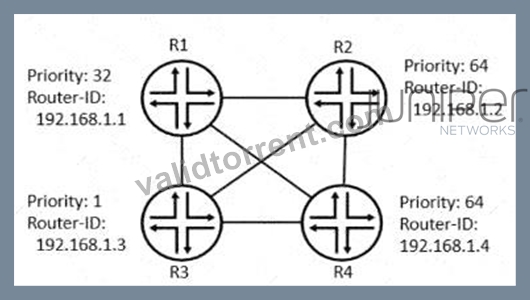
R1 was started at 4:00 PM. R2 and R3 were started at 6:00 PM. R4 was started at 10:00 PM. All routers are in Area 0 and there are no point-to-point links.
Referring to the exhibit, which router is the designated router?
- A. R4
- B. R1
- C. R2
- D. R3
Answer: A
NEW QUESTION # 72
Exhibit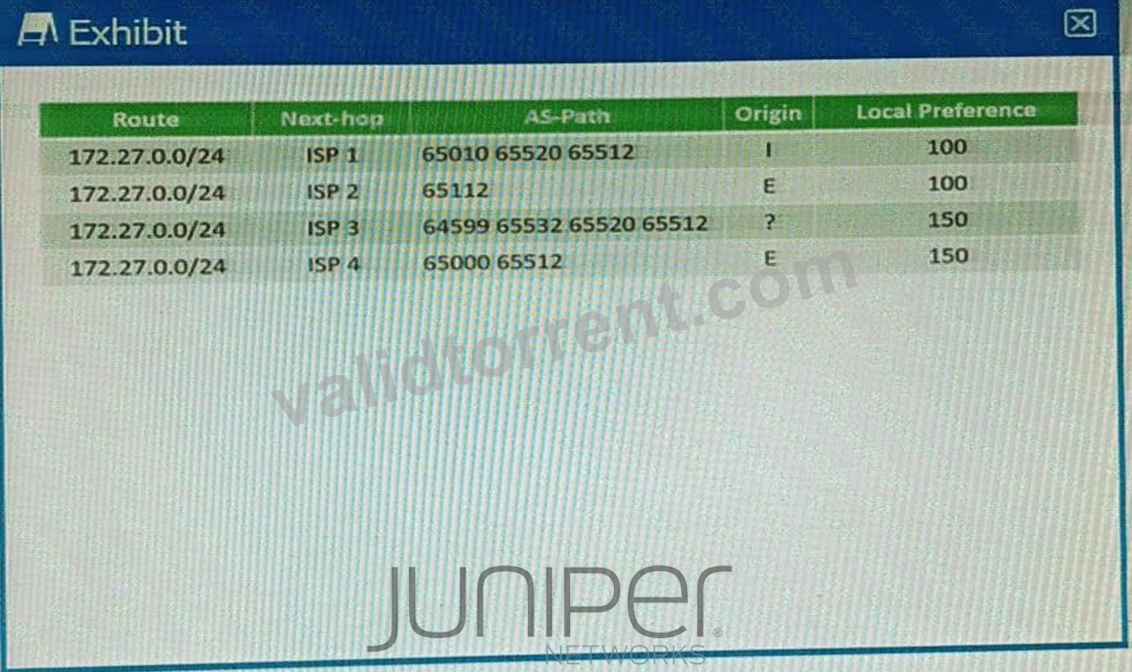
You are receiving the BGP route shown in the exhibit from four different upstream ISPs.
Referring to the exhibit, which ISP will be selected as the active path?
- A. ISP 3
- B. ISP 4
- C. ISP 2
- D. ISP1
Answer: B
Explanation:
In BGP, the path selection process is based on a set of attributes 1 . The process starts by preferring the path with the highest weight, then the highest local preference, then the locally originated routes, and so on 1 . If all these attributes are the same, then it prefers the path with the shortest AS path 1 .
Referring to the exhibit, all four ISPs have the same weight, local preference, and origin 1 . However, ISP 4 has the shortest AS path 1 . Therefore, ISP 4 will be selected as the active path. So, option C is correct.
NEW QUESTION # 73
......
JN0-351 Exam Questions – Valid JN0-351 Dumps Pdf: https://passguide.validtorrent.com/JN0-351-valid-exam-torrent.html