

Pass Cisco 200-901 PDF Dumps | Recently Updated 484 Questions
Updated Test Engine to Practice 200-901 Dumps & Practice Exam
Cisco 200-901 (DevNet Associate) Certification Exam covers a wide range of topics, including software development and design, APIs, Cisco platforms and development, infrastructure and automation, application deployment and security, and network fundamentals. 200-901 exam is designed to test candidates' knowledge and skills in these areas through multiple-choice questions, simulations, and hands-on exercises. 200-901 exam is available in English and Japanese, and candidates have 120 minutes to complete it.
Cisco 200-901: DevNet Associate exam is an essential certification for anyone who wants to start a career in software development or network automation. It covers a wide range of topics and tools that are relevant to the entire industry, and it is suitable for beginners as well as professionals who want to enhance their skills and knowledge. With this certification, you can demonstrate your proficiency in developing and maintaining applications on diverse platforms, which is a valuable skill for any organization.
Cisco 200-901 exam covers a wide range of topics, including the fundamentals of software development, APIs, and Cisco platforms. Candidates are expected to have a strong understanding of programming languages such as Python, JavaScript, and C++. They will also need to be proficient in using development tools such as Git, Docker, and Kubernetes, as well as familiar with software development methodologies such as Agile and Scrum.
NEW QUESTION # 102
A developer creates a program in which an object maintains a list of classes based on the observer pattern. The classes are dependent on the object. Whenever the state of the object changes, it notifies the dependent classes directly through callbacks. Which advantage of the observer pattern offers minimum dependencies and maximum flexibility between dependent objects or classes?
- A. tight coupling
- B. mediation
- C. loose coupling
- D. cohesion
Answer: C
Explanation:
The observer pattern is designed to create a relationship where an object (subject) maintains a list of its dependents (observers) and notifies them of any state changes. This pattern achieves loose coupling between the subject and its observers, allowing them to interact without being tightly bound to each other. This flexibility ensures that changes in the subject do not heavily impact the observers, and vice versa.
Reference: Cisco DevNet Design Patterns
NEW QUESTION # 103
Fill in the blanks to complete the python script to request a service ticket using the APIC-EM rest API for the user "devnetuser".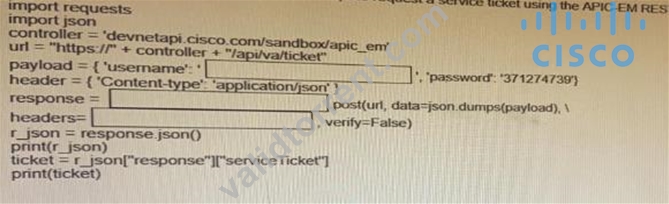
Answer:
Explanation:
devnetuser, requests, header
NEW QUESTION # 104
What is a concept of test-driven development?
- A. Tests that validate the functionality of the code are written before any code is written.
- B. Functions that validate the behavior of the product from the end user's perspective are written before any code is written.
- C. Business decision makers write tests to validate the product from the end user's perspective while the developer writes the code.
- D. One developer writes tests to validate the functionality of the code while another developer writes the code.
Answer: A
NEW QUESTION # 105
What are the two principles of an infrastructure as code environment? (Choose two)
- A. Environments must be provisioned consistently using the same inputs.
- B. Redeployments cause varying environment definitions.
- C. Components are coupled, and definitions must be deployed for the environment to function.
- D. Service overlap is encouraged to cater for unique environment needs.
- E. Complete complex systems must be able to be built from reusable infrastructure definitions.
Answer: A,E
Explanation:
Infrastructure as Code (IaC) involves managing and provisioning computing infrastructure through machine-readable definition files, rather than physical hardware configuration or interactive configuration tools.
Principles of IaC:
Reusability: Complete complex systems must be built from reusable infrastructure definitions. This means infrastructure components should be modular and reusable across different environments and applications.
Consistency: Environments must be provisioned consistently using the same inputs. This ensures that every environment is set up exactly the same way, reducing the risk of errors and discrepancies.
Other Principles:
Declarative Configuration: Using a high-level language to define what the infrastructure should look like rather than how to achieve it.
Incorrect Options:
C . Redeployments cause varying environment definitions: This is against IaC principles as it emphasizes consistency.
D . Service overlap is encouraged to cater for unique environment needs: This could lead to complex and unmanageable configurations.
E . Components are coupled, and definitions must be deployed for the environment to function: IaC promotes decoupled, modular components.
Reference:
Infrastructure as Code: IaC Principles
NEW QUESTION # 106 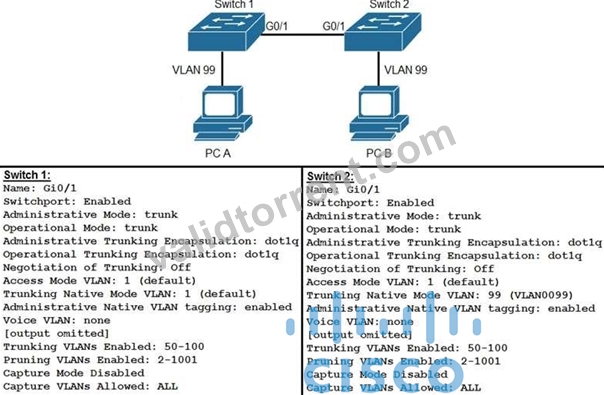
Refer to the exhibit. After the switch configuration, the ping test fails between PC A and PC B. Based on the output for switch 1, which error must be corrected?
- A. All VLANs are not enabled on the trunk.
- B. The PCs are in the incorrect VLAN.
- C. There is a native VLAN mismatch.
- D. Access mode is configured on the switch ports.
Answer: C
Explanation:
Section: Network Access
NEW QUESTION # 107
A development team needs to containerize an application named 'cust475605674\ A Dockerfile has been created and now the docker build command needs to be run using the current folder to find the Dockerfile. build the image and create a local repository named 'cust321453857-rep' that points to that image. Which command must be used?
- A. docker build cust321453857-rep -f Dockerfile.txt
- B. docker build -t cust321453857-rep Dockerfile.txt
- C. docker build -t cust321453857-rep -f Dockerfile
- D. docker build cust321453857-rep Dockerfile
Answer: C
Explanation:
To build a Docker image using the current folder and a specified Dockerfile, and then tag the image with a specific name for the local repository, the following command is used:
docker build: This command builds a Docker image from a Dockerfile.
-t cust321453857-rep: The -t option tags the resulting image with the specified name (cust321453857-rep).
-f Dockerfile: The -f option specifies the Dockerfile to use for building the image.
Command:
docker build -t cust321453857-rep -f Dockerfile .
Reference:
Docker Build Command: Docker Build
NEW QUESTION # 108
Refer to Exhibit.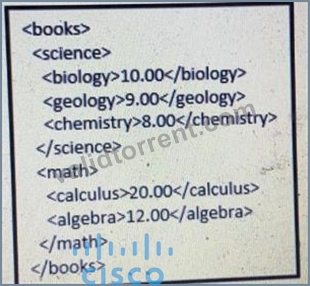
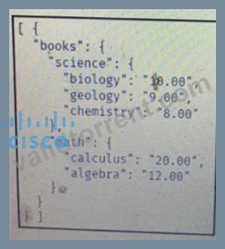
Which JSON is equivalent to the XML-encoded data.
- A.
- B.
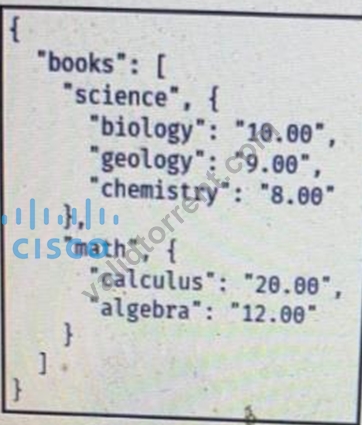
- C.

- D.

Answer: C
Explanation:
When converting XML to JSON, the structure should maintain the hierarchical organization and data representation. The provided XML structure:
<books>
<science>
<biology>10.00</biology>
<geology>9.00</geology>
<chemistry>8.00</chemistry>
</science>
<math>
<calculus>20.00</calculus>
<algebra>12.00</algebra>
</math>
</books>
translates to the following JSON structure:
{
"books": {
"science": {
"biology": "10.00",
"geology": "9.00",
"chemistry": "8.00"
},
"math": {
"calculus": "20.00",
"algebra": "12.00"
}
}
}
* Root Element: The root element <books> translates to a key "books".
* Nested Elements: The <science> and <math> elements become nested objects under "books".
* Leaf Elements: The individual subjects and their prices (e.g., <biology>10.00</biology>) become key-value pairs within their respective parent objects.
Option A:
json
Copy code
{
"books": {
"science": {
"biology": "10.00",
"geology": "9.00",
"chemistry": "8.00"
},
"math": {
"calculus": "20.00",
"algebra": "12.00"
}
}
}
This option accurately represents the hierarchical structure of the XML data, making it the correct equivalent.
Option B, C, and D:
* These options incorrectly use array notation for the nested objects, which is not consistent with the original XML structure. The XML structure indicates that "science" and "math" are single objects with multiple key-value pairs, not arrays.
References:
* Converting Between XML and JSON
* JSON and XML Comparison
NEW QUESTION # 109
Drag and drop the Python data transformation methods from the left onto the data formats on the right.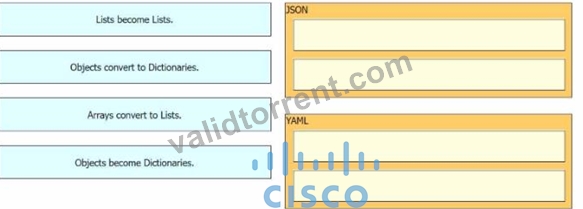
Answer:
Explanation: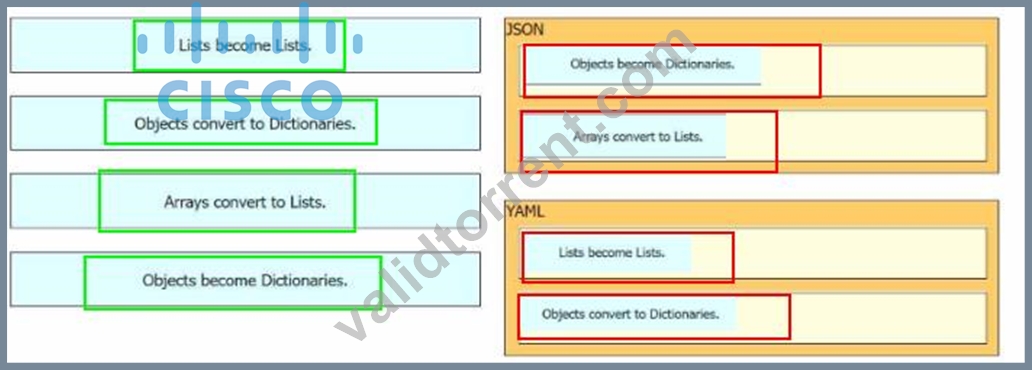
Reference:
JSON and YAML in Python: JSON Documentation, YAML Documentation
NEW QUESTION # 110
Which HTTP response status code means "Forbidden"?
- A. 0
- B. 1
- C. 2
- D. 3
Answer: B
Explanation:
https://developer.mozilla.org/en-US/docs/Web/HTTP/Status/403
NEW QUESTION # 111
What is the benefit of edge computing?
- A. It simplifies security as devices and processing are brought closer together
- B. It removes the need for centralized data processing.
- C. It reduces network latency by moving processing closer to the data source.
- D. It reduces data velocity from devices or other data sources.
Answer: C
Explanation:
Edge computing is a distributed computing paradigm that brings computation and data storage closer to the sources of data. This helps to:
Reduce Latency: By processing data closer to where it is generated, edge computing reduces the time taken for data to travel to a central server and back. This is especially important for applications requiring real-time or near-real-time responses.
Optimize Bandwidth: Reducing the amount of data sent to a central data center can conserve bandwidth and lower costs.
Enhance Security and Privacy: Processing data locally can enhance security and privacy by minimizing the exposure of data during transmission.
NEW QUESTION # 112
Which REST architectural constraint indicates that no client context should be stored on the server between requests?
- A. uniform interface
- B. cacheable
- C. client-server
- D. stateless
Answer: D
Explanation:
Reference: https://developer.cisco.com/docs/nx-os/#!representational-state-transfer-rest
NEW QUESTION # 113
What are two advantages of the MVC design pattern? (Choose two.)
- A. It represents the visualization of data contained with a model.
- B. It separates low-level data accessing operations from high-level business services.
- C. It controls the data flow into a model object and updates a view whenever data changes.
- D. It allows filtering of a set of objects using different criteria.
- E. It builds a final object through a step-by-step approach.
Answer: B,C
NEW QUESTION # 114
What is the main purpose of a code review?
- A. To detect logical errors
- B. To ensure that all code is checked in simultaneously
- C. To identify and review errors with the team
- D. To provide the technical lead visibility into all code
Answer: C
Explanation:
The main purpose of a code review is to identify and review errors, ensuring code quality and adherence to coding standards. It involves evaluating the code for bugs, security vulnerabilities, and performance issues, and discussing potential improvements with the team. This collaborative process helps catch errors early, fosters knowledge sharing, and improves the overall quality of the codebase.
Reference:
Cisco DevNet Associate Study Guide: Code Review Best Practices (Chapter 6, Section: Importance of Code Reviews).
NEW QUESTION # 115
An engineer deploys a Cisco CSR 1000 V instance to a virtual machine. The engineer must output the device configuration in JSON format. Which protocol is used for this task?
- A. NETCONF
- B. SNMP
- C. RESTCONF
- D. YANG
Answer: C
NEW QUESTION # 116
Refer to the exhibit.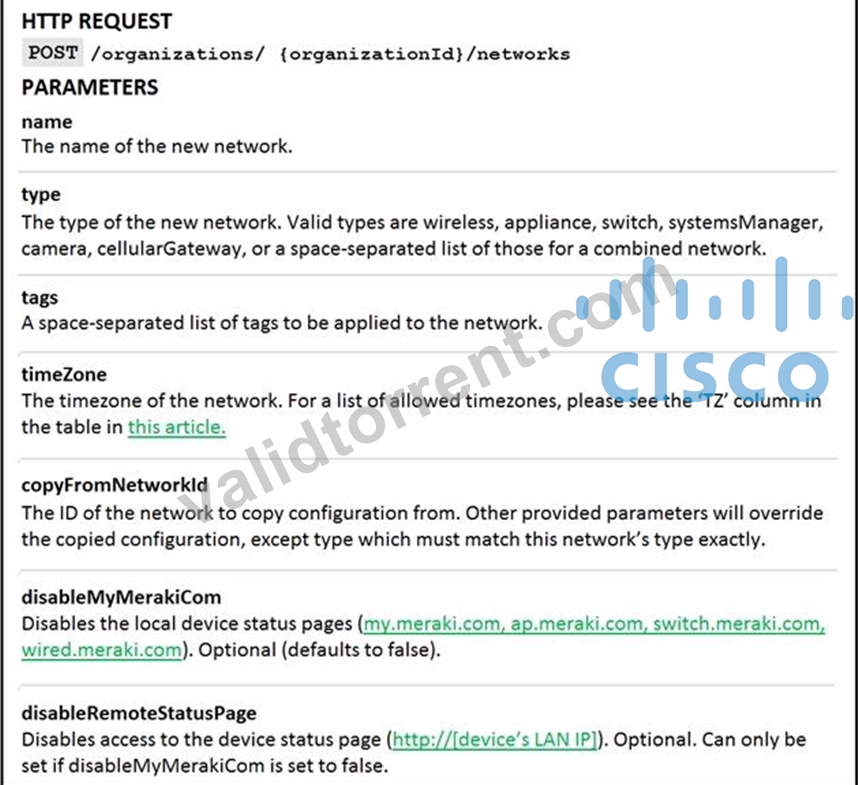
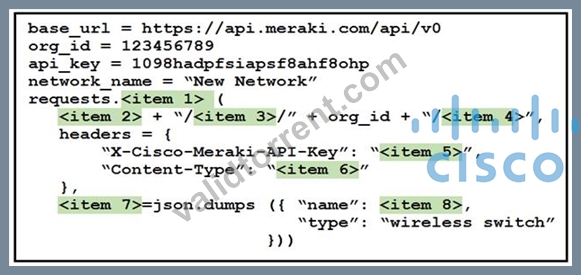
Drag and drop the code from the left onto the item numbers on the right to complete to Meraki python script shown in the exhibit.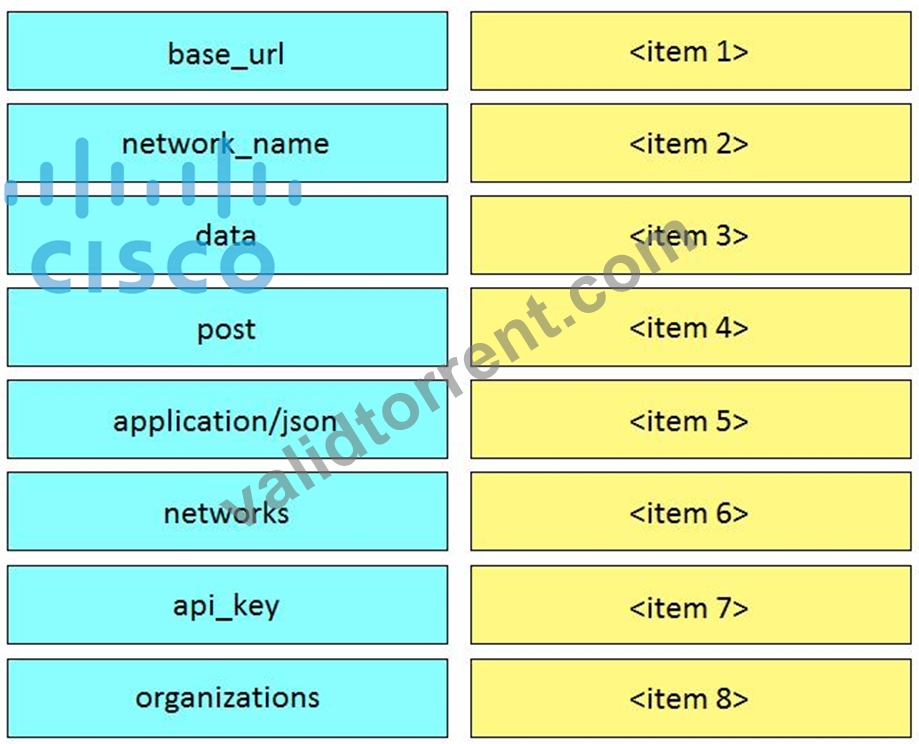
Answer:
Explanation: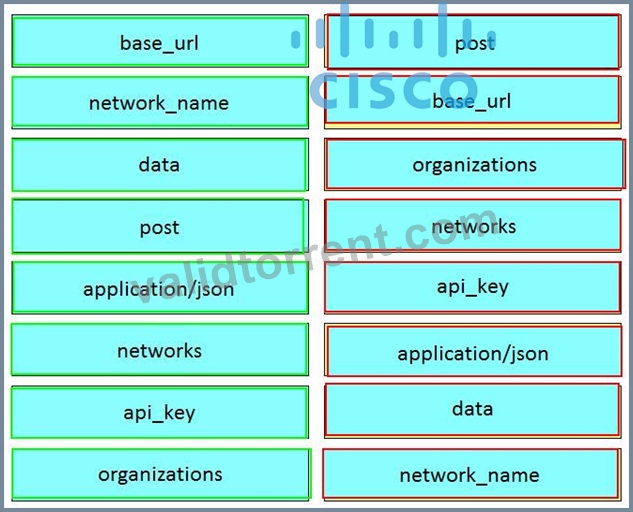
NEW QUESTION # 117
Drag and drop the HTTP methods from the left onto their generally accepted corresponding create, read, update, and delete operations on the right.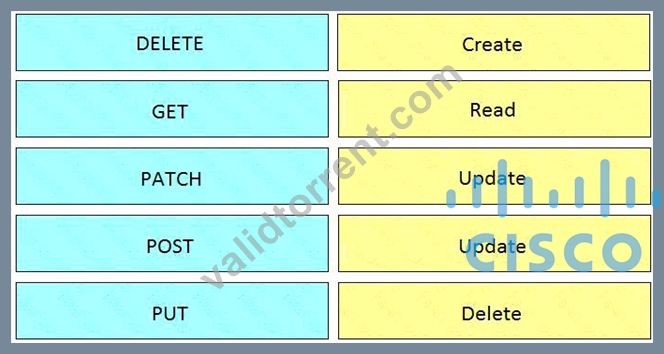
Answer:
Explanation: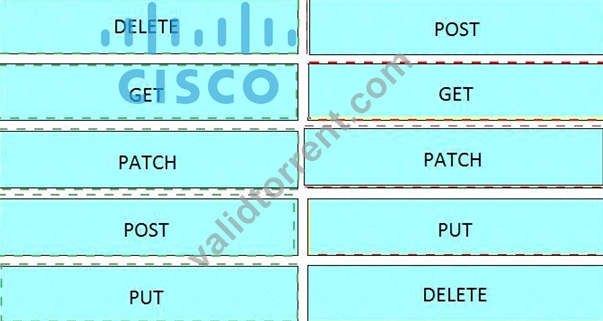
Explanation:
1 - D, 2 - B, 3 - C, 4 - E, 5 - A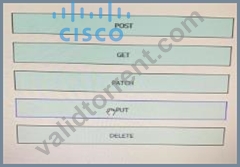
Reference:
https://www.cisco.com/c/en/us/td/docs/cloud-systems-management/application-policy-infrastructure-controller-e OR Answer :
Post
Get
Put
Delete
NEW QUESTION # 118
Which HTTP status Code means that the server cannot or will not process the request because of perceived client error?
- A. 0
- B. 1
- C. 2
- D. 3
Answer: C
Explanation:
The HTTP status code 400 indicates that the server cannot or will not process the request due to a client error.
HTTP Status Code 400 - Bad Request:
Meaning: The server cannot process the request due to a client-side error. This could be due to malformed request syntax, invalid request message framing, or deceptive request routing.
Common Causes: Typical reasons for a 400 Bad Request include incorrect URL formatting, invalid query parameters, or unsupported characters in the request.
Client Error Category: Status codes in the 4xx range indicate client errors, where the problem lies with the request sent by the client rather than the server.
Other Status Codes:
100 - Continue: Informational status code indicating that the initial part of a request has been received and the client can continue with the rest of the request.
203 - Non-Authoritative Information: The server successfully processed the request, but the information may come from a different source.
303 - See Other: The server is redirecting the client to a different resource, typically using the GET method.
Reference:
HTTP Status Codes: MDN Web Docs
RFC 7231: HTTP/1.1 Semantics and Content
NEW QUESTION # 119
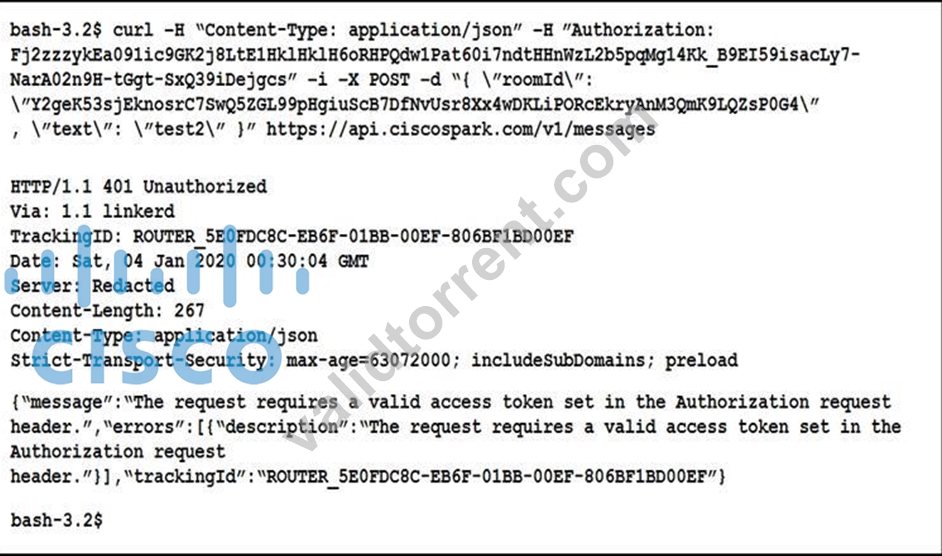
Refer to the exhibits. A developer is troubleshooting an API with the given API documentation and cURL command. What is the cause of this problem?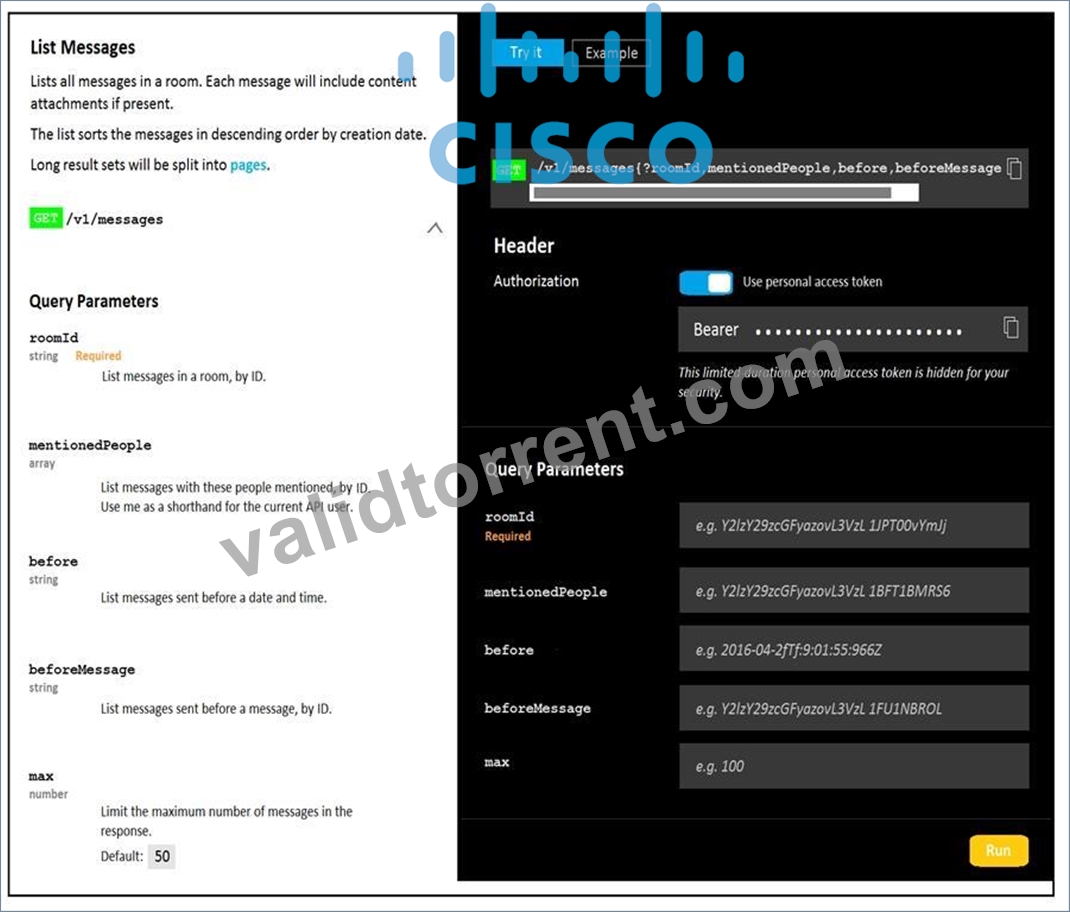
- A. The authorization header is missing or incomplete
- B. The user is not allowed to post massages from their account
- C. The API token specified is expired
- D. The request body is missing or incomplete
Answer: A
Explanation:
The authorization header is missing or incomplete because it has the token BUT the Bearer keyword is missing.
NEW QUESTION # 120
To which stage of development do Infrastructure as Code principles relate?
- A. service provisioning
- B. requirement collection
- C. physical deployment
- D. manual configuration
Answer: A
NEW QUESTION # 121
An existing application is accessible from an external IP address. Which device or service must be configured to make the application accessible through a URL by using a domain name?
- A. reverse proxy
- B. firewall
- C. DNS
- D. load balancer
Answer: C
NEW QUESTION # 122
Refer to the exhibit.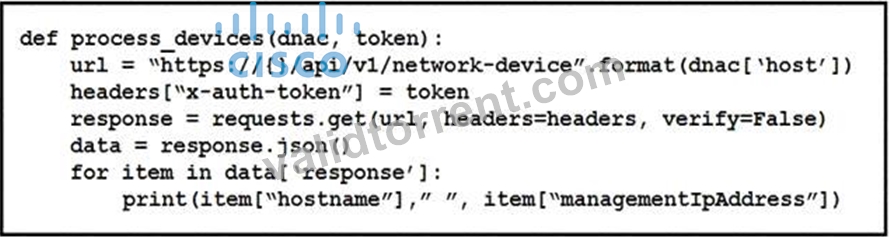
What is the function of the python script?
- A. For each device that is returned, display the device and, for each device, print the device name and management IP address.
- B. Iterate over a list of network devices and write all device type and associated management IP address.
- C. Count and print the total number of available devices.
- D. Iterate over a list of network devices and write all device names and management IP addresses to an output file.
- E. Loop through the returned list of network devices and, for each device, print the device name management IP address.
Answer: E
NEW QUESTION # 123
An engineer must investigate the problems on a web application and address them to related teams. The engineer verifies the application reachability from the single public IP dress with port and discovers that HTTPS access works to three servers of a network farm with IP 172.16.50.1 .2 and .4. but HTTPS access to the server with IP 172.16.50.3 does : work. Which problem type must be addressed as the cause for the case?
- A. NAT
- B. proxy
- C. VPN connectivity
- D. blocked transport port
Answer: D
Explanation:
The issue described indicates that HTTPS (port 443) access is not working for one specific server (172.16.50.3) in the network farm, while it works for the others. This suggests that the transport port (port 443) might be blocked or filtered for this particular server.
Transport Port Blocking: Network firewalls or security groups might block specific ports for certain IP addresses.
Server Configuration: The server might not have the necessary configuration to accept HTTPS connections on port 443.
Troubleshooting: Verifying firewall rules, security group settings, and server configurations can help identify and resolve the issue.
Reference:
Network Troubleshooting Guide: Troubleshooting Network Issues
NEW QUESTION # 124
......
Cisco 200-901 Dumps Cover Real Exam Questions: https://passguide.validtorrent.com/200-901-valid-exam-torrent.html